Thursday, January 2, 2014

Interesting Fruits from Dieng Plateau

Dieng Plateau is a volcanic caldera complex located in Central Java. As the plateau is located 2000m above sea level, the cool weather allows for the cultivation of many temperate and sub-tropical vegetables and fruits. There are two kinds of fruits grown in Dieng that I would like to share here. Coincidentally, both fruits have the specific epithet pubescens, meaning hairy or covered in hairs and are not commonly seen in warm, lowland tropical climes.
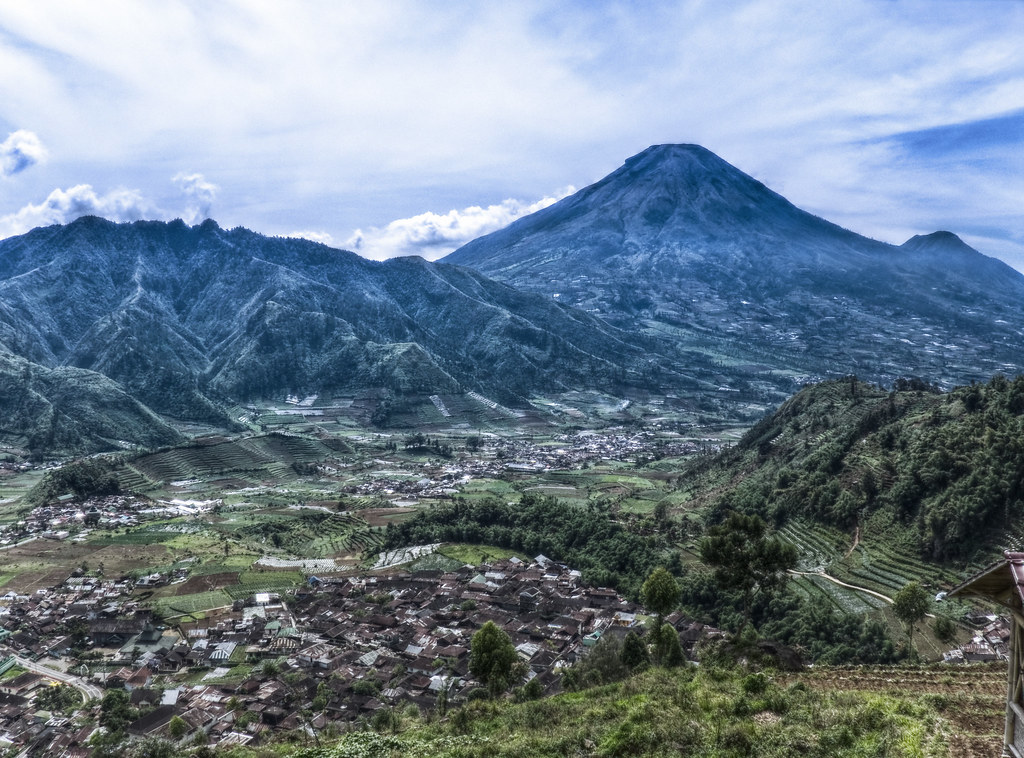
View of the villages below and mountains to the southeast from the viewing tower on the way up to Dieng Plateau.
The two widely sold fruits in Dieng. One is a chilli pepper and the other is a relative of the papaya.


Carica Dieng
The first one is a fruit that grows on a papaya-like trees that is planted along the slopes on the road up to and on Dieng Plateau. Indeed one can see signs on stalls like 'bibit Carica untuk dijual' (meaning Carica seedlings for sale) or 'Oleh-oleh Khas Carica Dieng' (Speciality food gift of Dieng Carica). Carica is the genus of the papaya fruit but the trees here are distinctively different from the lowland papayas. They have more finger-like leaf lobes and the fruits are small and very angular. 
Fresh Vasconcellea pubescens in trays, boxes of processed Vasconcellea pubescens in syrup (sold as Carica Dieng) and Dieng chilli pepper on a stall at the Candi Arjuna complex in Dieng.

This is actually Vasconcellea pubescens. It was formerly known as Carica pubescens LennĂ© & K.Koch, Carica candamarcensis Hook.f., or Vasconcellea cundinamarcensis V.M. Badillo. Hence the locals here call it Carica and markets the product as Carica Dieng. In other places, they are known as mountain papaya or mountain pawpaw. Vasconcellea pubescens are native to the Andean range on the northwestern part of South America from Colombia south to central Chile, and typically grows at altitudes of 1,500–3,000 m (4,900–9,800 ft). They are also grown on the mountains of Sri Lanka and South India has has been known to do well at 1800 ft (549 m) in Puerto Rico. This plant is apparently resistant to papaya viruses thus is of great interest to plant breeders.
Along the way, one can see papaya-like trees of Vasconcellea pubescens being grown on the lower slopes of the terraced hillside.

Sometimes called Papayuela, the outer flesh is firm, and needs to be cooked (e.g. in syrup as commonly sold in Dieng) and has a texture that is reminiscent of peaches. The inner pulpy flesh and the seeds can be eaten raw, and taste like a cross between passion fruit and pineapple to me. Seeds are dark brownish and surrounded by a jelly sac, very much like Carica papaya
The mountain pawpaw or papayuela.

In Dieng, you can buy processed Vasconcellea pubescens fruit in syrup or get them fresh. The fruit does not seem to like heat, and turned soft rather quickly in the lowland heat. I actually didn't buy any, for I am always vary of anything papaya (they give me the runs). Luckily our good friend and local guide, Ary bought some and insisted we try. The aroma and acidity of the pulp would probably go well with yoghurt and ice-creams in the same way as passion fruit pulp does. It is an interesting  fruit that is not so commonly seen, especially in the warm tropics.


Cabe Gendot / Cabe Khas Dieng
Another Andean plant fruit that is grown and sold in Dieng is the cabe gendot or gendol. This chilli pepper is shaped like a jalapeno, but my oh my is it hot! Many people are confused and think that this chilli pepper is a Capsicum chinensis (aka habanero) type but cutting the fruit open provides you with the identity of this cabe gendot. Firstly, the flesh is thick, and secondly, the seeds are black! C. chinensis have thin flesh and yellow seeds. The only domesticated chilli pepper that is widely grown with black seeds and thick flesh is Capsicum pubescens Ruiz & Pav.
A lady bagging Capsicum pubescens for sale at Dieng. They tend to sell them green. At some stalls, you can pick the cabe gendot that you want, be it red or green. 
The black seeds and relatively thick flesh for a small chilli pepper is a dead giveaway of its identity.

Bite into the flesh of this chilli pepper, and you will notice a slight bitter taste similar to a green bell pepper. This is masked by the somewhat fruity taste of the chilli pepper (citrus-like to some people). Then the heat kicks in. They burn your lips and hands, especially if you handle the placenta and seeds. Getting the seeds out resulted in my hands having burning sensation that lasted till the next day! And you wouldn't want to know how it felt when the chilli pepper came out on the other end! 
A bunch of Capsicum pubescens tied with raffia string. The shape of the chilli peppers looks like a long rocoto chilli pepper.

The specific epithet pubescens means hairy as the leaves and plants are hairy. They have purple flowers and is regarded as one of the more primitive Capsicum species. The plants are known as tree chilli as the roots lignify rather quickly and they sometimes takes on a vining habit. Some examples of C. pubescens cultivars include Rocoto, Manzano and Canario.

So if you go to Dieng in Central Java, don't forget to try the Carica Dieng (shouldn't they call it Vasconcellea Dieng now?) and the cabe gendot Dieng.

Friday, December 20, 2013

Pre December Solstice Purple Sweet Potato Harvest

How fast time flies, for tomorrow is already Winter Solstice (or Summer Solstice for those Down Under). To clear up a few containers on the balcony, I decided to pull out the purple sweet potato that I planted in August. Actually, at the 2 month mark, I had already seen a tuber form in one of the two containers, but didn't bother to harvest it in November when it reached the 3 month mark post-planting. As time goes by, the containers that they were in were getting more and more distorted, and even the soil had begun to rise.
Purple Sweet Potato flowers hanging off the balcony.

Despite the time-frame and the visual clues, I was reluctant to harvest it, for it kept on providing the balcony with lovely clusters of purple flowers that dangle off the balcony. After visiting Diana at KBB, and receiving some precious seeds to plant, I got on to reorganising the plants on the balcony (hmm, sounds like a never ending process) and today, I finally got to harvesting the sweet potato. This is also to throw out the old compost that they are growing in that had a few pest issues.
They are pretty good bloomers, with at least 5-6 blooms every other day!

The first container that was quite severely distorted and also had soil that was lifted up from beneath yielded 4 tubers. Mind you, the containers are only 29.5cm long x 12cm high x 11.3cm at the widest (top part). The middle section of the container is no wider than 8cm, and I had only 6 inches of soil as I filled the pot with charcoal pieces to make sure that the soil had ample drainage.
The blue lines mark the original soil surface which is now tilted to one side. The lighter blue area shows the level of the soil that was lifter up off the container, and the bulge on the side of the container can be seen. Mesti ada ubi di dalam.
Four oddly shaped purple sweet potatoes. The container had an inch of charcoal chips lining the bottom, thus limiting the space that is available for them to grow.

The second container also showed some distorted, but with less of a soil uplifting. This container only gave two normal tubers, one thin tuber that is probably from a pencil root and a lot of red coloured pencil roots. The thing is, this is the container that receives more fertiliser as any excess liquid fertiliser gets dumped into this container.
The second container yielded a whole bag of pencil and fibrous roots, plus two normal tubers and a swollen pencil root that is oddly bent like a U.
That is all folks...all the purple sweet potato that I got from the balcony. Not too bad for small containers and little care other than water, sunlight and minimal fertiliser.

The conclusion from this sweet potato patch are:

  • too much fertiliser = a lot of pencil and fibrous roots
  • more sun = more tubers
  • no need to line the bottom of the containers with charcoal/rocks for drainage
  • small containers = funny shaped tubers like really flat on one side.


Now to find something to cook the weirdly-shaped purple sweet potato with.

Wednesday, November 27, 2013

Rhinoceros Hornbills of Ampang Forest Reserve

There is a place around KL where you can see Rhinoceros Hornbills flying free, and no, I am NOT talking about the KL Bird Park. This place is the little known Ampang Forest Reserve or better known locally as Taman Rimba Ampang. Located about 10km from KLCC, the Ampang Forest Reserve is popular with locals who go for a dip in the shallow river that runs along the road that leads to a water treatment plant.
Rhinoceros Hornbill (Buceros rhinoceros) at Ampang Forest Reserve. The dark eyes (reddish in colour) tells me it is a boy. His partner flew to another portion of the canopy that was obscured from my view. The upturned, yellow-red casque, black neck and face and a horizontal black stripe in the mid-section of the tail is diagnostic of this species. This bird was going after the two orange-red fruits dangling above.

Rhinoceros Hornbills (Buceros rhinoceros) is one of the largest Asiatic hornbills, with a body approximately the size of a swan and have the usual pied body color i.e. black and white. They are found from the south of Thailand down through to the Malay Peninsula, in Sumatra and also in Borneo. Many would have heard their calls before, but fail to realise that it was a hornbill for they sound more like the noise a mammal would make.

Hence, when you visit this forest reserve, do keep an ear out for the calls of the hornbills. You can, for most of the time, hear their calls from the forest to the left of the river (after the river passes under the road, the same side as a small surau).
The beautiful stream/shallow river at the forest reserve. I heard the hornbills calling, but as I was doing long exposures, I wouldn't have enough time to reposition and shoot the hornbills.

At the end of the road is a water treatment plant, that has been operational since the British colonial rule. This water treatment plant draws water from the catchment area in the surrounding hills. The trees around the entrance of this water treatment plant are good spots to catch a glimpse of the Rhinoceros hornbill.

They can be clearly seen when they drop by the tree tops by the road to feed on the climbing figs that grow there, which appear to be Ficus punctata, another root climbing fig of the subgenus Synoecia (like Ficus pumila and Ficus villosa), with golf-ball sized fruits. So do familiarise yourself with their calls and 'barks' that can help you pinpoint their location.
Peekaboo, I see you. The male Rhinoceros Hornbill browsing for figs. He is very good at picking the fruits and sort of flipping it down its beak.
The black, horizontal band on the tail of the Rhinoceros Hornbill. The orange ball to the right of the bird is the fruit of a climbing fig, most likely Ficus punctata syn. Ficus aurantiaca. Ficus aurantiaca is an illegitimate name for this fig.

The Ampang Forest Reserve is however, doomed to suffer future degradation. Middle of 2013, the KL Outer Ring Road (KLORR) project was approved after the EIA was passed (it was rejected twice), and the highway will cut and fragment the forest reserve. Worst still, the Ampang exit for the KLORR highway will run by the side of the river, the area where I could hear the hornbills calling from! Sadly, we seemed to have a strange concept of solving problems and an even stranger government where water shortage is an issue and yet catchment area forests are allowed to be encroached upon. Then come up with strange water transfer projects that disturbs the environment further.
The guardian of the forest reserve. Long-tailed macaques were feeding on wild figs (Ficus hispida) growing along the side of the road.
A Tree Nymph butterfly (not to sure which one - the wingspan is pretty large and hind wings rather pointed as seen in the picture). It was taking short flights around a small patch of undergrowth. They are pretty interesting to watch, especially when flying/gliding down the a clearing. The Malay name for the tree nymph butterflies is surat, meaning letter.

There has been attempts to highlight the issue of the forest reserve and to stop the highway, which was supposed to be part of the Taman Warisan Negeri Selangor. Hopefully something good comes out of it. If that fails, do go and have a look at Ampang Forest Reserve and the magnificent Rhinoceros Hornbills before its too late. They might not hang around so close to the city once the highway construction starts. 

To get to the forest reserve, drive along Jalan Ampang towards the hills and keep on driving (keep going past Ampang Point and past Ampang Waterfront) until you reach the end of the road. There is an arch with the name of the forest reserve and a public parking spot on your right. You can park here or drive further in where there are smaller car parks. My advice is to park outside and walk in. This will help cut down the noise and air pollution.


My list of plants and animals seen in Ampang Forest Reserve that I will continuously update:

Figs
Ficus hispida
Ficus fistulosa
Ficus villosa
Ficus punctata
Ficus sp. (strangler fig, broad-leafed)
Ficus sp. (tree with slender trunk)
Ficus sp. (white fruits)

Orchids
Bulbophyllum sp.
Thecostele/Thecopus sp.
A few Aeridinae orchids


Birds
Rhinoceros Hornbill (Buceros rhinoceros)
Oriental Magpie Robin (Copsychus saularis)

Butterflies
Tree Nymph (?Idea sp.)
Grass Yellow - most likely Common Grass Yellow (Eurema sp.)

Mammals
Spectacled Leaf Monkey/Dusky Leaf Monkey (Trachypithecus obscurus)
Long-talied Macaque (Macaca fascicularis)